Through highs and lows, space collaboration between Washington DC and New Delhi traces back to the heydays of the Cold War and the formative years of ISRO. Will Artemis unfurl a new leaf in this relation?
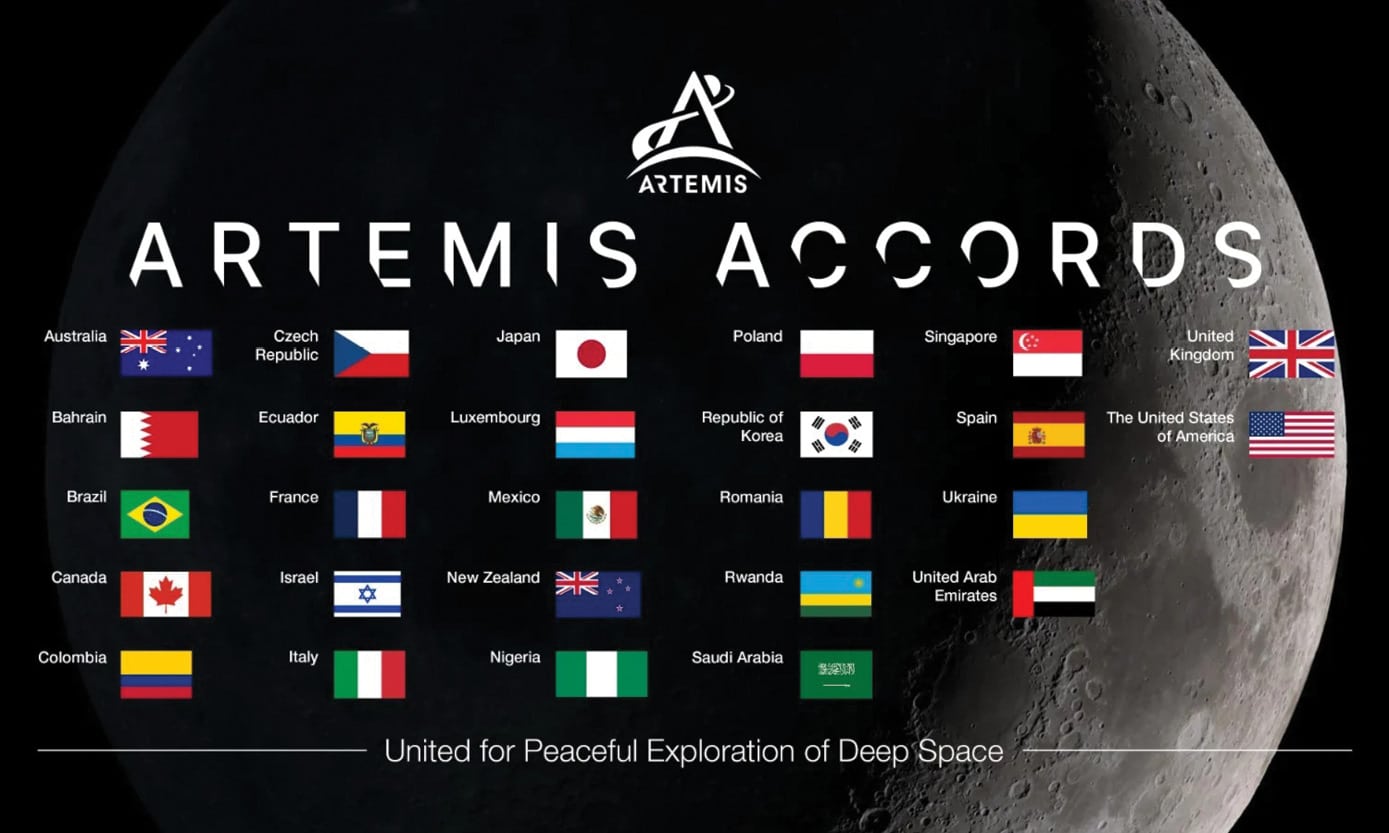
Indian PM Modi’s visit to the US, amid much fanfare and joint communiques on deepening space collaborations, coincided with India signing the US-led Artemis Accords, becoming the 27th country to join the non-binding agreement that prioritizes space sustainability and lunar flight.
The official joint statement by President Biden and Prime Minister Modi, during the visit in June, talks about India and USA setting “a course to reach new frontiers across all sectors of space cooperation” The two leaders “applauded our growing cooperation on earth and space science, and space technologies”.
This includes, inter alia, developing a strategic framework for human spaceflight cooperation by the end of 2023 and the delivery of the NASAISRO Synthetic Aperture Radar (NISAR) satellite to ISRO’s U.R. Rao Satellite Centre in Bengaluru, India”. NISAR is expected to be launched by 2024.
Additionally, Biden and Modi called for enhanced commercial collaboration between the U.S. and Indian private sectors in space, and addressing export controls and facilitating technology transfer.
“President Biden deeply appreciated India’s signing of the Artemis Accords, which advance a common vision of space exploration for the benefit of all humankind.”
The Backdrop: Space Joint Working Group
Just preceding PM Modi’s visit, the eighth meeting of the U.S.- India Civil Space Joint Working Group (CSJWG) was held on January 30-31 at the Department of State in the US Government.
The media note released after the meeting said “The CSJWG discussions covered collaboration in Earth and space science as well as human space exploration, global navigation satellite systems, spaceflight safety and space situational awareness and policies for commercial space.”
“Participants also considered implementation of guidelines and best practices developed by the United Nations Committee on the Peaceful Use of Outer Space (COPUOS) to ensure the longterm sustainability of outer space activities”, as per the note.
The CSJWG had its genesis in a joint seminar conducted by the American Institute of Aeronautics and Astronautics, AIAA and the Indian Astronautical Society in Bangalore during June, 2004 at Bangalore. In March 2005 the governments of US and India set up the CSJWG and the Joint Working Group held its inaugural meeting in Bangalore, India, on June 29-30, 2005.
The areas of cooperation identified at the first meeting were Chandrayaan-1, India’s GAGAN using GPS, a possible earth reception station in India for the U.S. National Polar-orbiting Operational Environmental Satellite System (NPOESS), investigation on the comparability and complementarity of data from Landsat and IRS satellites.
The US government report on the meeting also noted that “Closer cooperation in international initiatives such as the Group on Earth Observation as well as efforts to develop a multiple hazards early warning and response system will serve national objectives of both sides.”
It also emphasized on the presence of strong complementarities in satellite communications and its various applications, along with space education and training.
A Look Back Into History
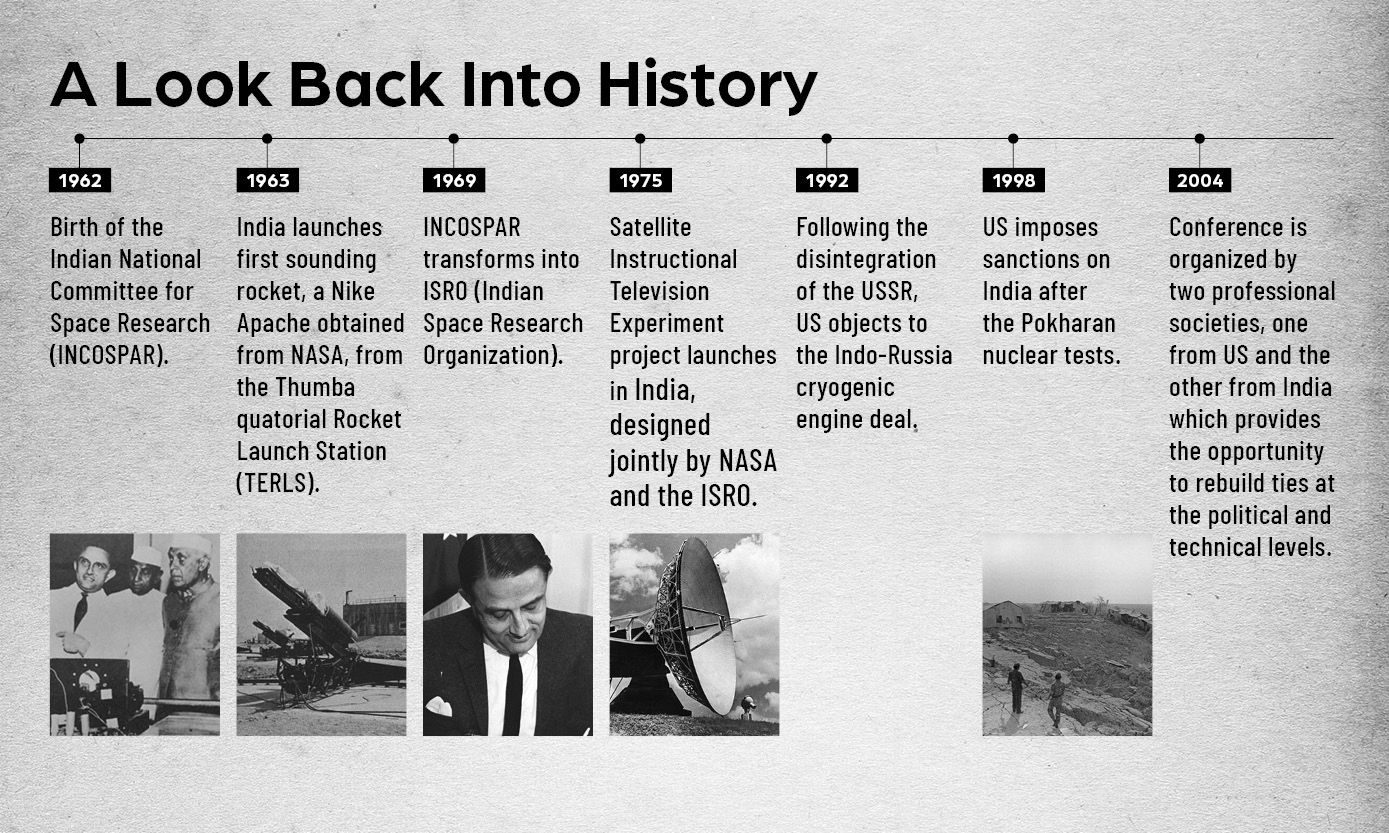
To take a glimpse into the past, India and USA have had a long association right from the birth of Indian National Committee for Space Research, INCOSPAR in 1962.
INCOSPAR engineers were trained at NASA’s Goddard Spaceflight Centre and Wallops Island facility for sounding rockets during 1963.
The same year, India launched its first sounding rocket, a Nike Apache obtained from NASA, from the Thumba Equatorial Rocket Launch Station (TERLS ), which was also setup with US assistance.
TERLS was designated as a UN facility to promoting common scientific research during the Cold War era.
Seven years later, in 1969, INCOSPAR transformed into ISRO ( Indian Space Research Organization), whose first major applications program known as Satellite Instructional Television Experiment( SITE) used a NASA satellite ATS-6 to beam educational programs to direct satellite TV receivers installed in 2400 remote villages across India. Through this programme ISRO intended to showcase the capability of satellite broadcasting to reach the unreached and in general to show the efficacy of space for development.
Arnold Frutkin, the then Assistant Administrator for International Affairs at NASA who steered the program, reminisces that this was one project where they invited participation hoping that people would be interested and when it would work well, they would be interested in continuing it commercially.
“India contracted with Ford Aerospace for a commercial satellite to continue their programs, and they contracted for a number of Ford Aerospace satellites over the years. The point is: this program not only was an educational lift to India and demonstrated what such a satellite could do, but it brought money back into the Unites States through commercial contracts for satellites for a number of years”, says Futkin.
Articulated years after the program, this ringside viewpoint highlights US commercial expectations in a government-to-government program.
It would be prudent to keep this in mind even as we enter the Artemis Accord and hope for enhanced commercial collaboration between the U.S. and Indian private sectors in the entire value chain of the space economy, addressing export controls positively and facilitating technology transfer.
The Trade Journey So Far
India has been a major trading partner of the US in Space technology and services since 1976 after the conclusion of SITE. The FACC contract for INSAT1A to 1D, as well as supply of components, computers, and launch services for the INSATs were all part of the commercial deals. However, it is also important to remember that things were not always hunky-dory.
After the Pokharan nuclear tests, US imposed sanctions on India, which led to denial of critical components, super computers and made further collaboration between the entities of the two countries difficult if not impossible.
In 1992, following the disintegration of the USSR, US objected to the Indo-Russia cryogenic engine deal and Russia was forced to renege and work out a new deal without technology transfer.
The sanctions slowed down the progress in critical areas but it could not stop India. Workarounds were implemented such that India was able to indigenously develop two critical technologies – supercomputers and cryogenic engines.
The US understood that sanctions were not working because India had a workforce that was successful in the development and applications of space and information technologies on their own.
This forced a rethink in the US policy circles. In 2004, a conference organized by two professional societies, one from US and the other from India, provided the opportunity to rebuild ties at the political and technical levels.
The setting up of the CSJWG was a political decision taken in 2005 and continues to operate till this day.
One of the outcomes of the cooperation outlined in the CSJWG in its first meeting in 2005 resulted in Chandrayaan 1 carrying NASA’s Moon Minerology Mapper which detected water trapped in minerals on the Moon.
The lander of Chandrayaan 3 has a NASA supplied Laser Retroreflector fo ranging studies. The NISAR project due for launch in 2024 includes an L-band synthetic aperture radar, a highrate communication subsystem for science data, GPS receivers, a solid-state recorder and payload data subsystem from NASA. ISRO is providing the spacecraft bus, the S-band radar, the launch vehicle and associated launch services.
Possible Opportunities
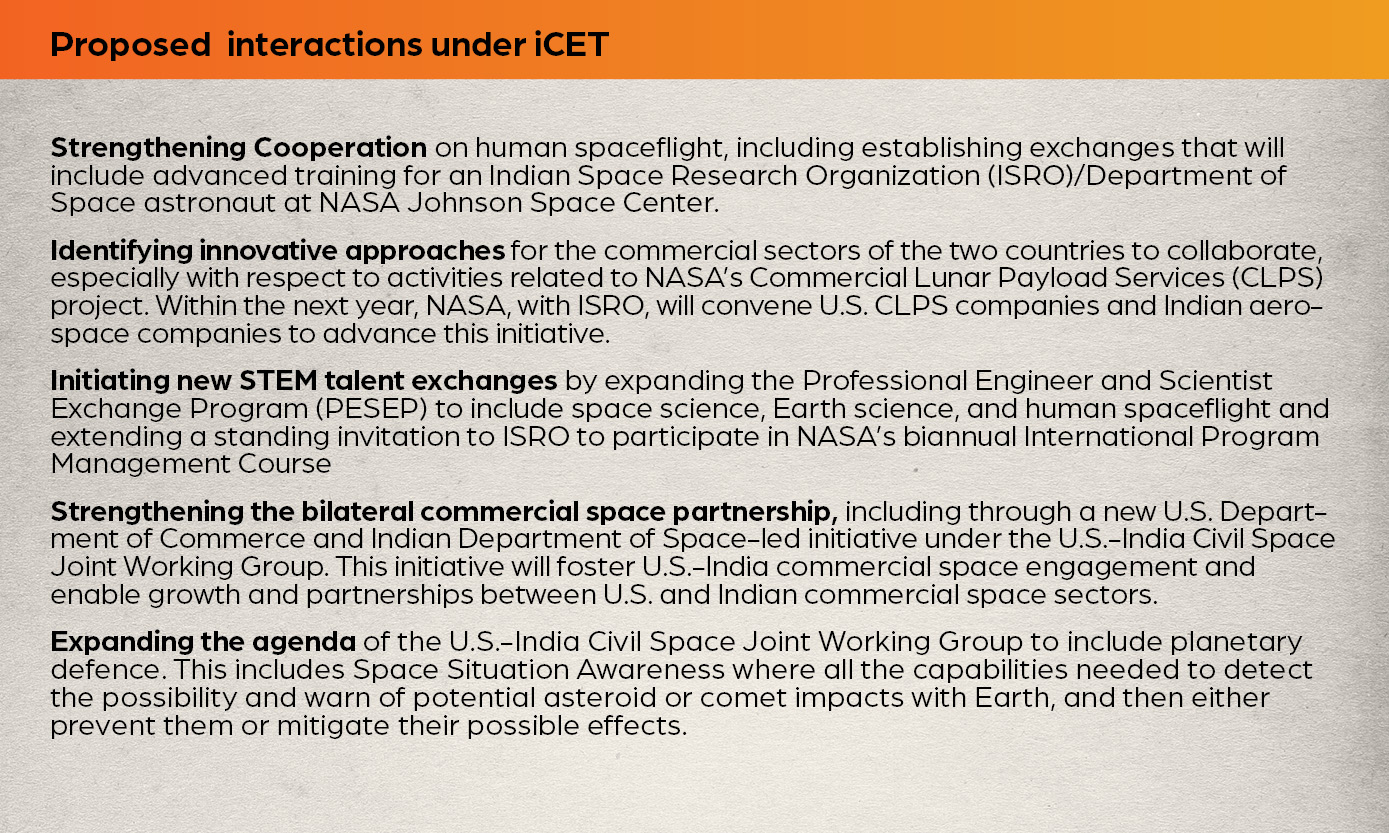
The May 2022 briefing by the White House indicates the direction that the interaction between USA and India on Space. The preamble states that, “President Biden and Prime Minister Modi announced the U.S.-India initiative on Critical and Emerging Technology (iCET) in May 2022 to elevate and expand our strategic technology partnership and defense industrial cooperation between the governments, businesses, and academic institutions of our two countries”.
The CLPS programme intends to land specific instruments on the moon at specific locations to study an aspect of the Moon. These landers are contracted out to various US vendors. For example, Astrobotics is providing two landers to NASA which will carry NASA instruments to the moon. Indian industry needs to explore opportunities in collaboration with American firms who have already been awarded contracts.
Opportunities under the US Department of Commerce and India’s Department of Space, DoS also need to be explored. This may require that the CSJWG include members from the Indian Space industry to take forward the collaboration between American and Indian firms. Indian industry has begun to address the SSA and these efforts could be further enhanced and presents a good opportunity for collaboration under the proposed Planetary Defence programme.
Impact of the Artemis Accord
In this context, it is necessary to examine the benefits, if any, arising from India signing the Artemis Accord.
The Accord mainly concentrates on “civil space activities conducted by the civil space agencies of each Signatory. These activities may take place on the Moon, Mars, comets, and asteroids, including their surfaces and subsurfaces, as well as in orbit of the Moon or Mars, in the Lagrangian points for the Earth-Moon system, and in transit between these celestial bodies and locations”. Clearly earth based activities are excluded.
Currently, Chandrayaan 3 is on its way to the Moon. Its Lander and rover will explore the area near the Lunar south pole. Aditya-L1 is slated to occupy the Lagrangian-1 zone. Since these activities are after India has signed the Accord the conditions of the Accord should apply.
The Road Ahead
Apart from the CSJWG and the iCET, there are really no other opportunities which have arisen from the Indo-US Joint statement. The CSJWG is akin to a mela. The seventh meeting, held in November 2019, had 52 Indian government and 243 US government participants.
A few glaring questions arise: What would be the outcomes of such a huge gathering? Were there any side meetings which could have led to some concrete decisions? The absence of any industry participation is glaring.
The first move should be for India to bring in private space industries as observers in the CSJWG. A working group of US and Indian firms could follow, to spell out the possible cooperation.
As of now, the nearest realizable opportunity is that of the CLPS which awaits a NASA-ISRO move to convene an interaction between US and Indian firms.
According to Ranjana Kaul of Dua Associates, there are already many opportunities for private firms with the Government opening Space up to the private sector and the reorganization of DoS but “the moot point to consider for these companies is – at what point in time or when might government allow commercial private launch service providers?”
Further, “Will these companies be permitted to export launchers or provide services from spaceports in other jurisdiction? If this does not happen and the governing statutes/regulations are not reformed in time how will these companies navigate the way ahead. Perhaps the satellite manufacturers may be able to – but the launcher manufacturers?”
Both governments are talking about strategic technology partnership and defense industrial cooperation between the governments, businesses, and academic institutions of the two countries. But, as Ranjana points out “How easy/hard is it [for India] to break into the US and possibly the Global market and will the initiatives remove/ lessen roadblocks?”
Susmita Mohanty, Director General, Spaceport SARABHAI, feels that India has to significantly increase its Space budget to be able to play a meaningful role in the Artemis programme.
She also feels that a coalition of space-faring nations who have signed the UN Moon Agreement and Artemis Accord be formed to send a message that notwithstanding India signing the Artemis Accord, India is committed to a multilateral approach as enshrined in the Outer Space Treaty and Moon Agreement.
The CSJWG and the iCET, along with the possible NASAISRO initiative for convening an industrial interaction are all very good ideas. Signing the Artemis Accord is a major step forward, though now both governments need to walk the talk.