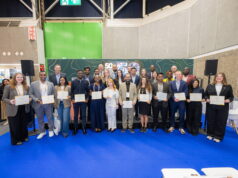
The 3rd Annual India Space Congress (ISC) 2024, a three-day event dedicated to elevating India’s space capabilities through international collaboration commenced today.
Organized by SIA-India, the conference brought together a diverse array of engaging discussions and exhibitions under the theme ‘Space Innovation: Bridging Boundaries and Transforming Tomorrow,’ held at The Lalit, New Delhi.
The first day of the conference and exposition received an overwhelming response from the global space industry. More than 300 organisations participated with close to 200 speakers.
Highlights for day 1 included the sharing of a strategic MoU between Mount Tech Growth Fund- Kavachh (MGF-Kavachh) and SIA-India, and the release of the whitepaper “Bridging the Digital Divide in India via Satellite” by SIA India by none other than the three chairmen, of ISRO, TRAI and INSPACe.
ISC 2024 began with enthusiastic participation from space legends, innovators, disruptors, global delegates, and rising stars in the space industry.
The event featured special addresses from esteemed dignitaries, including Shri S Somanath, Secretary DoS and Chairman, ISRO; H E Mr. Philip Green OAM, High Commissioner of Australia to India; Dr. Pawan Kumar Goenka, Chairman, IN-SPACe; Shri Anil Kumar Lahoti, Chairman, TRAI; Air Vice Marshal Rahul Bhasin, ACAS (Ops) Space, Air HQ on behalf of Air Marshal Amar Preet Singh PVSM, AVSM; Mr. Rainer Horn, Managing Partner, Novaspace; and Mr. Deepak Mathur, Executive Vice President, SES.
The day concluded with participation from over 700 delegates and 300 organizations from 30 countries.
Key remarks from the day included:
Somanath, Chairman of ISRO: “ISRO has created significant space capability and talent in the country. It’s time for new actors to scale India’s space operations. Bringing down the cost of access to space is a global trend, and India must also look at it. Space can never be solely for business and economy; it must inspire generations to innovate for humanity.” He also mentioned the upcoming launch of the GSAT-20 is a high-throughput Ka-band Satellite, with > 50gbps high bandwidth connectivity capacity.
Dr Pawan Kumar Goenka: “All space startups in India are deep-tech and exploring new frontiers. We have more than 200 startups, and this number will rise post-FDI policy. He also boasted about the enthusiasm of the private sector and how the investments are looking highly positive with the private space sector in India receiving $135 million in investment last year alone.”
Mr Anil Kumar Lahoti: “Satellite technology is experiencing revolutionary growth and will play a vital role in enhancing connectivity in remote areas.”
H E Philip Green OAM, High Commissioner of Australia to India: “We now describe India as a top-tier strategic partner in space, alongside the USA and Japan. Australia’s unique geography and competencies in robotics, composites, and rare earth materials position us as a valuable partner for India.”
AVM Bhasin: “Air and space operations cannot be segregated and conducted in isolation. The future involves evolving the Indian Air Force into a force capable of seamless operations in air and space domains.”
Dr Deepak Mathur, SES: “We are moving from arithmetic progression to geometric progression of progress, from being risk-averse to full throttle. The space industry is ripe for bridging the digital divide, with over 10,000 space firms globally.”
Rainer Horn, Novaspace: “India has put itself on the global map for space and is now a serious global player. We anticipate a 60% growth in Indian space investments over the next 10 years.”
Dr Subba Rao: “The Indian ecosystem is integrating into the global supply chain to bring the benefits of space to all, aiming to make India the hub of global satellite manufacturing.”
The inaugural day featured diverse sessions on policy innovations, space sustainability, and cutting-edge technologies like mega-constellations and satellite IoT ecosystems. These sessions explored critical intersections between space and biology, engineering advancements, and legal frameworks shaping space missions. Key discussions on international collaboration, defence applications, and next-gen satellite networks highlighted the space sector’s strategic advantages and economic opportunities.
The day also included country sessions focused on Switzerland and Italy’s space sectors and their opportunities for Indian companies, along with a session on the Global Space Coalition: Uniting Nations for a Shared Future in Space, emphasizing the importance of global cooperation.