To discuss the topic “New Era of Space Mobility”, and the prospects of private players in the European Space market, Geospatial World discussed with the CEO and Co-founder of IENAI SPACE, Dr. Daniel Perez Grande.
Spain-based IENAI SPACE is a five-year-old startup, which has recently raised 3.9 million euros after the successful in-orbit demonstration of ATHENA.
Pixxel announced that it has officially signed the landmark 350th iDEX contract with the Ministry of Defence at a ceremony in New Delhi.
Awarded as the first-ever iDEX Prime (Space) Satellite Grant under the Mission DefSpace Challenge, this contract empowers Pixxel to develop miniaturized multi-payload satellites for the Indian Air Force.
The contract was signed between Awais Ahmed, CEO of Pixxel, and Shri Anurag Bajpai, Additional Secretary (Defence Production) and CEO of IDEX-DIO, in the presence of Defence Secretary Shri Giridhar Aramane, the Vice Chiefs of the Armed Forces, and other officials of the Ministry of Defence.
Awais Ahmed, Founder and CEO of Pixxel, expressed his gratitude and excitement: “The iDEX Prime Space grant received by Pixxel is the first-of-its-kind grant for satellites. The official signing of the contract today is a testament to Pixxel’s dedication to advancing space technology in the country and reflects the government’s confidence in our satellite manufacturing capabilities. We are honoured to receive this support and look forward to utilising it to develop cutting-edge multi-payload satellites that push the boundaries of space exploration.”
Received as part of the SPARK grants by iDEX, this contract will initiate Pixxel’s efforts to develop small satellites of up to 150 kg for Electro-Optical, Infrared, Synthetic Aperture Radar, and Hyperspectral purposes.
The 350th contract will enable innovation in space electronics, allowing for faster and more economical deployment, ease of manufacturing, scalability, adaptability, and less environmental impact.
The SPARK grants are offered to startups selected through the iDEX (Prime) and DISC initiatives to empower Indian innovators and entrepreneurs to deliver technologically advanced solutions in India.
Pixxel emerged as the grant winner among many companies due to its pioneering technology in hyperspectral satellite manufacturing.
As Pixxel sets out to launch six commercial-grade hyperspectral satellites, ‘Fireflies’, this year, the company remains committed to harnessing its indigenous expertise and the power of hyperspectral satellites for a sustainable future.
Building on its expertise, Pixxel now offers high-performance, cost-effective satellite manufacturing solutions, empowering clients to drive meaningful change with space data.
The Geospatial Sector is going through a transformation with Cloud Computing at the heart of the change. The power, scalability and accessibility of Cloud Computing were the highlights of the panel chaired by Dr VS Hegde, Chairman cum Managing Director, Antix Corporation and Scientific Secretary ISRO.
He emphasized on shifting focus to “downstream” activities in the space economy. This means utilizing geospatial data to create meaningful applications and services that benefit society. Cloud technology, he noted, is essential for this transition, providing the infrastructure for storing, processing, and analysing the huge swarth of data generated by satellites.
He said, “Building Satellites, Launching Satellites… it is all upstream activity which is a part of 12-15 % of the overall space economy. So it is downstream that decides the space activities where space and all applicable data are used. We need to focus on downstream possibility which makes use of the cloud technology.”
Cloud, the Geospatial Game Changer
Phil Cooper, Geospatial Technical Business Development Lead, AWS EMEA, highlighted the “titanic shift” to the cloud in the geospatial sector.
He said “The sheer volume of data involved, from satellite imagery to environmental sensors, demands the scalable and flexible solutions that cloud platforms offer. AWS, for instance, stores a staggering 160 petabytes of open geospatial data. ”
The Landsat program is the longest-running enterprise for the acquisition of satellite imagery of Earth which according to Phil has been severely underutilized.
From Geointelligence to Sustainable Agriculture
The applications of cloud-powered geospatial technology are vast and varied. In GeoIntelligence and security, cloud computing enables real-time monitoring and analysis of critical situations.
Divya Sharma, Vice President, Satsure, a company focused on agricultural solutions, shared how cloud technology is democratizing access to data, enabling them to develop crop monitoring tools that benefit low-income farmers and enhance food security.
She said, “At Satsure, We are trying to solve low-income farmer inclusion. As 70 per cent of the population is involved with Agriculture, this is a large-scale problem we tackle.
“Availability of data and democratization of data (which AWS has brought in) has helped with this crop monitoring in agriculture. We monitor the entire lifecycle of the different stages of Agriculture. If we have this open data, structured and organized we can use it. We can have much more Intel in developing models like climate change.”
Naresh Palaiya, CTO of Tathya.Earth, highlighted the use of cloud-based deep learning algorithms to extract insights from satellite imagery.
This allows for the identification of economic trends and patterns that were previously difficult to discern. The cloud, in essence, is a catalyst for innovation in the geospatial domain.
While the potential of cloud technology is undeniable, challenges remain. Data storage, while vastly improved by cloud solutions, is still a concern. Additionally, the sheer complexity of geospatial data can pose challenges for analysis and interpretation.
However, LLM models in AI and ML running on cloud infrastructure are helping to address these hurdles.
The future of geospatial tech is irrefutably intertwined with the cloud. As data volumes continue to grow and analysis becomes more complex, the cloud will provide to be very integral.
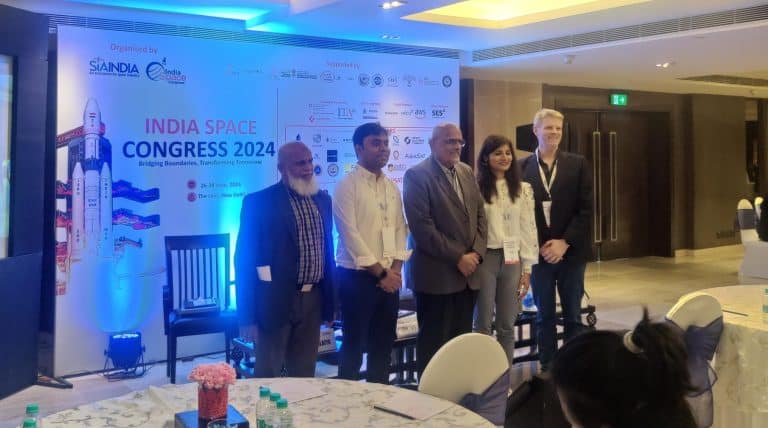
The Indian Space Congress 2024 began with an exciting inaugural session, setting the tone on India’s growing prominence in the global space landscape. Dr Subba Rao, President of SIA-India, highlighted the ambition for India to become a central player in the global space ecosystem. He said, “The Indian ecosystem is going to be integrated into the global supply chain, to bring the benefit of space to all. We aim to make India the hub of global satellite manufacturing, forging way ahead to a Viksit Bharat by 2047.
This vision aligns with a broader push to use space technology for development across sectors like telecommunications, disaster management, and more.
Innovation with Multi-Orbit Strategy
The evolution of the Satellite industry has been very incremental in India. A multi-orbit satellite strategy uses a network of satellites in different orbits to provide a range of solutions for different applications. This strategy aims to match the right application to the right orbit.
Deepk Mathur, Executive Vice President, SES Satellites emphasized the need for both reliability and disruptive innovation. He stressed the importance of a multi-orbit strategy to address diverse applications, stating:
“Multi-Orbit Strategy will serve more applications than ever. The progress that’s been in the last 2 years outweighs the 28 years of development prior. There needs to be space based connectivity to bridge digital divide, enable future mobility, extend cloud to edge, fast track earth observation data sets and manage risk in conflict and disaster”.
Mathur also stressed the importance of localized solutions and collaboration to foster a robust supply chain ecosystem within India.
Satellite Technology’s Role in the Space Sector’s Growth
Several trends fuel the growth of the Indian Space Sector. Rainer Horn, Managing Partner from Novaspace identified four key trends driving this growth. These include having an Expanding pool of investors, Affordable access to space, Defence and security concerns and Growing demand for space-based applications.
These trends, coupled with regulatory developments and advancements in LEO broadband and IoT, are creating a fertile ground for innovation and investment.
AVM Rahul Bhasin, ACS (OPS) Space, Air Hqr added on the point of the importance of integrating space situational awareness with air situational awareness. He said, “There is a need for international cooperation in this domain to ensure the safety and security of space assets.”
Anil Kumar Lahoti, Chairman of TRAI, highlighted the role of satellite technology in providing high-speed broadband services and expanding connectivity to rural and untouched areas. He noted the potential of satellite technology in disaster management, sustainable development, and achieving Sustainable Development Goals.
Future of India’s Space Startups
The space sector has been a significant success story for Indian startups where tech players develop solutions to make India self-sufficient. Dr. Pawan Goenka, Chairman of InSpace, highlighted the rapid growth of India’s space start-up ecosystem.
He said, “There are now over 200 startups in the Indian space sector now. In the last 12 months, lot of developments have happened in the space sector with both the government and private sector. We are working on two areas, one is the whole regulatory, authorization area where we are making good progress and the other is driving Indian Space economy. These two tracks, scientific exploitation where ISRO is leading the way and all the space startups is in deep tech and are at an inflexion point.
Somanath, Secretary of DoS and Chairman of ISRO addressed the challenges and opportunities transitioning towards greater private sector participation in the Indian Space Sector.
He said, “The Journey of India’s Space Actors has not been an easy one. From governmental to private, new actors must emerge. Within ISRO & DOS, we must chart the future. The gap between civilian space and strategic space is becoming narrower. Access to space must become cheaper. Exploration inspires this generation and future generations, but we need to develop the technology for it.”
He raised points on bringing down the cost of access to space, the emergence of constellations for communication, and the need to inspire future generations through space exploration.
Today’s news cover,Posspole and Karnataka Maritime Board Sign MoU for Maritime Ecosystem Development, Airbus takes a charge of nearly $1 billion on space programs,Waymo makes autonomous ride-hailing service available to all in San Francisco, NASA, SpaceX Launch NOAA’s Latest Weather Satellite, HERE Technologies Launches Fleet Optimization Package, Bowman Selected to Provide Orthoimagery Services for the State of Oregon, ITU and WATRA unite to enhance ICT infrastructure mapping, Techtree Innovation-Seoul Collaborate on Hyper-Realistic Digital Twin Project, Pixxel Signs Contract to Develop Miniaturised Multi-Payload Satellites
Space Machines Company, an Australian-Indian in-space servicing firm, has signed a landmark Launch Service Agreement with NewSpace India Limited (NSIL), a Govt. of India company under the Department of Space and the commercial arm of the Indian Space Research Organisation (ISRO).
This pioneering collaboration sets the stage for the launch of Space Machines Company’s second Optimus spacecraft weighing 450kg, the largest Australian-designed and built spacecraft so far. Slated for a dedicated launch aboard NSIL’s Small Satellite Launch Vehicle (SSLV) in 2026, this mission will mark a defining moment for both nations in the area of space collaboration.
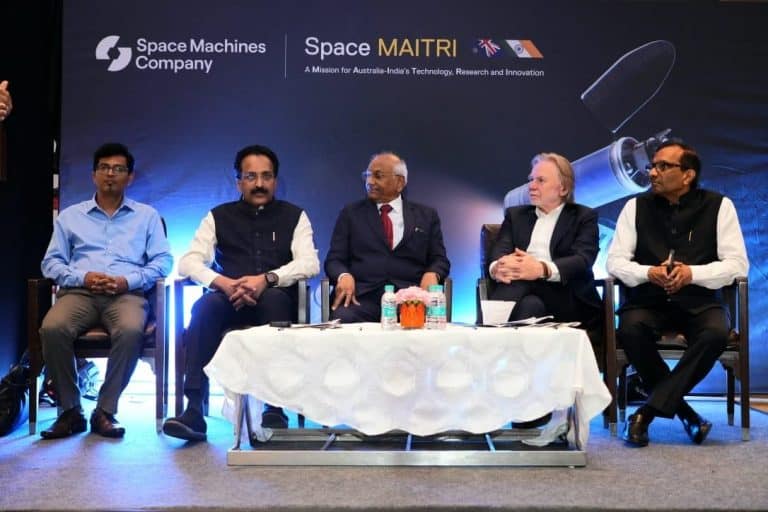
This mission, named Space MAITRI मै ी (Mission for Australia-India’s Technology, Research and Innovation), marks a significant milestone in the strategic partnership between Australia and India in the space domain, fostering closer ties between commercial, institutional, and governmental space organisations from both nations.
By focusing on debris management and sustainability, the mission aligns with the core values and objectives of both countries, promoting responsible space operations and mitigating the growing threat of space debris.
At the India Space Congress 2024 held in Delhi, Rajat Kulshrestha, CEO and Co-Founder of Space Machines Company, and Mr Radhakrishnan Durairaj, Chairman and Managing Director of NSIL, formally announced the signing of the Launch Service Agreement.
“This collaboration with Space Machines Company exemplifies the spirit of international cooperation in space and highlights the strategic partnership between Australia and India,” said Mr Radhakrishnan Durairaj, NSIL Chairman and Managing Director. “As a Launch service provider for the Optimus spacecraft, we are not only fostering the growth of our respective space industries but also contributing to the sustainable exploration and utilisation of space.”
In April 2024, Space Machines Company announced that the Space MAITRI project had received an $8.5 million grant from the Australian Government through the Australian Space Agency’s International Space Investment India Projects (ISI India Projects) program.
“The Space MAITRI mission and our collaboration with NewSpace India Limited represents a significant leap forward for Australia’s space industry. By combining our innovative spacecraft capabilities with India’s proven launch expertise, we are not only strengthening the ties between our nations’ space sectors but also demonstrating our shared commitment to sustainable space operations,” said Rajat Kulshrestha, CEO and Co-Founder of Space Machines Company.
The Space MAITRI mission involves several Australian and Indian partner companies collaborating with Space Machines Company, including Ananth Technologies, Digantara, The University of Adelaide, The University of Sydney, The University of Technology Sydney, LeoLabs, Advanced Navigation, and the Australian Strategic Policy Institute (ASPI).
“It is terrific to see this historic launch agreement signed here today between Space Machines and NewSpace India Limited. Australia and India are important strategic and natural partners in the space sector; an inherently global industry,” said Mr Philip Green OAM, Australian High Commissioner to India.
“We share an understanding of the importance of space to support progress here on earth, and Australian companies are well prepared to support joint projects with India for critical space-related products and services. From Australia’s geographical location and world-leading technologies to our R&D, human and talent capital, Australia has much to offer when it comes to space.”
Head of the Australian Space Agency, Enrico Palermo, said the agreement is an important step towards enhancing Australia’s space heritage and strengthening our relationship with India.
“This formal agreement and mission will leverage our countries’ respective capabilities and unique strengths to make space activities more sustainable.”
“Like India, Australia’s commercial space sector is rapidly growing, and we are producing innovative space technologies that benefit life on Earth. The mission will inspire future explorers and further enhance international cooperation in this critical domain,” said Mr Palermo.
The mission underscores Space Machines Company’s unwavering commitment to fostering sustainable space operations. With the rapid proliferation of satellites launched by various entities, the ever-growing cloud of space debris encircling Earth poses an escalating threat to future space endeavours and astronaut safety.
Through this groundbreaking collaboration, Space Machines Company, NSIL, and mission partners will spearhead the development of solutions to mitigate space debris, raise global awareness, and revolutionise in-space services, ensuring the long-term sustainability of space.