Grab, a prominent technology company in Southeast Asia, has developed its in-house mapping system called GrabMaps to provide efficient and accurate navigation for its services.
Challenges
This case study explores how GrabMaps overcomes the challenges of Southeast Asia’s unique local nuances that makes navigation difficult by collecting region-specific data, leveraging machine learning, and prioritizing user preferences.
The challenges faced are:
- The lack of available suppliers for maps that could meet their specific requirements.
- Third-party map providers often provided or offered generic data that did not account for the Southeast Asia region’s local nuances.
Solutions
Building Localized Mapping Data
In 2017, Grab’s Geo team made the strategic decision to develop its own maps for Southeast Asia by collecting and classifying mapping data in a local context. This included
- Identifying and mapping small and narrow roads commonly used as shortcuts,
- Capturing colloquial place names, and
- Recognizing priority places such as prayer rooms that are essential for specific Southeast Asian countries.
Machine Learning for Continuous Improvement
Grab has developed country-specific machine learning models that are continually optimized to reduce inaccuracies and gaps in mapping data.
- The system collects real-time feedback from driver-partners on the road, both manually and passively.
- It monitors road closures based on driver feedback and recognizes patterns where multiple driver-partners avoid certain roads, indicating potential roadblocks.
Customized Routing and Point of Interest (POI) Identification
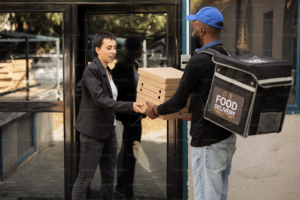
GrabMaps considers factors such as specific vehicle types and user preferences, to optimize routing and identify points of interest. For e.g., GrabMaps differentiates drop-off points for passengers and food orders from restaurants.
By capturing POI data directly, Grab ensures that its delivery driver-partners are routed to the correct locations, avoiding unnecessary detours.
The system also guides driver-partners to the appropriate parking spaces based on their vehicle type and provides visual cues, such as photos, to help them navigate to the closest entry point or pick-up desk.
Benefits
- GrabMaps can adapt and update its data in realtime, providing reliable navigation information.
- Maximize food and mart delivery opportunities and minimize wasted time for driver-partners.
ALSO READ: Streamlining Shopping Experiences with Indoor Navigation