Digital Twin for Visibility, Viability, and Connectivity

The value of a Digital Twin is an exponential function of how much we can connect. By synchronizing the virtual and the physical, we get all-round connectedness. Digital Twins can connect workflows and help solve a lot of pressing challenges, and make us future-ready, says Greg Bentley, CEO, Bentley Systems.

COVID has accelerated the ongoing trend of digitalization. Do you see this trend continuing in a post-pandemic world?

At the beginning of the pandemic, we were compelled to virtualize all our organizations globally, including those in India. Initially, the pace was slow and we faced enormous inflection. But now that all of us can work virtually, the infrastructure engineering organizations of the world have actually recognized they have more opportunities and benefits this way. They can work on any project or asset from anywhere in the world without the constraint of location.

The trends in 2020 were driven by immediate necessity. Post 2021, we have been able to apply this notion of future-proofing our workflows through digitalization, as our infrastructure can get challenged any time by sudden shocks and disruptions, such as the pandemic.

“Building Back Better” is a phrase that is commonly used today. In general, it’s a timely reminder of the necessity of resilience in workflows. Unanticipated disruptions are not just limited to the pandemic or localized outbreaks in some parts of the world, they can also be violent flare-ups or natural disasters. In order to curtail such disruptions and pave the way for a world that is equipped to withstand shocks, climate adaptation and energy transition are crucial.

Many things have changed irretrievably because of the pandemic. Going forward, digitalization will be more crucial. The role of Digital Twins will be further enhanced with simulation, visibility, and analytics. Metaverse is the new buzzword, where, with the help of our digital context, digital components, and digital chronology, we can review, predict, and experiment with all that makes up a Digital Twin.

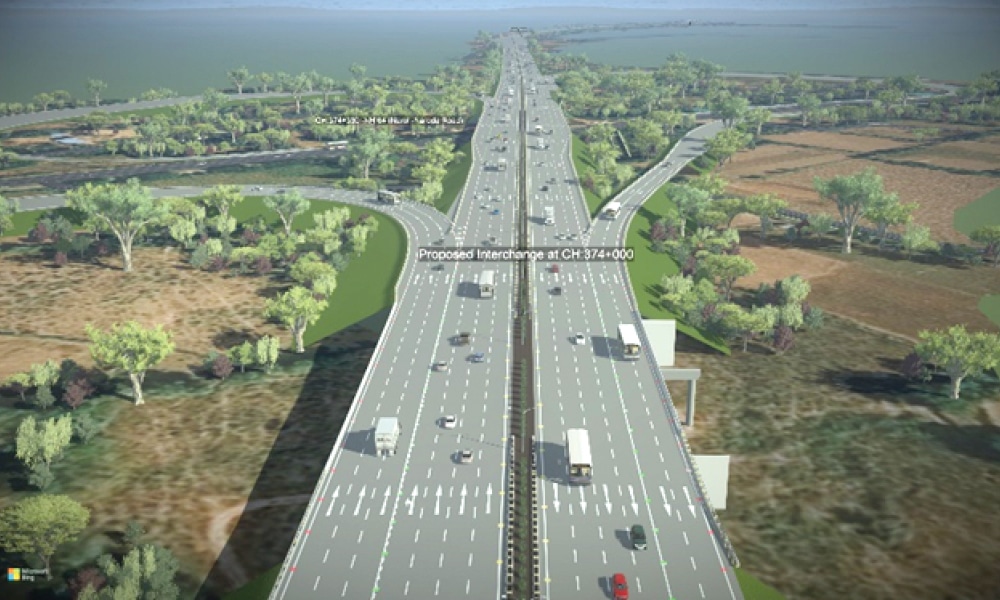
Larsen & Toubro have designed and built a 23.7-kilometer section of a 1,350-kilometer, eight-lane expressway between Delhi and Mumbai. To model the complex plan, they created a 3D model, which helped to accurately model the area and overcome terrain challenges. The collaborative model simplified the layout, resolved clashes with existing assets, led to an optimized design, and reduced resource hours by 25 percent.

Today, we are better prepared for resilient infrastructure, because we achieved resilience in our infrastructure engineering functions and organizations during the pandemic. We coped with something we didn’t anticipate, and we will attune our infrastructure even more against future shocks.

The construction industry was earlier resistant to digitalization but today digitalization is ubiquitous; and we are seeing innovations taking place around, as they are called, connected constructions and live connections. In this context, what are the technology innovations around infrastructure digitalization that you foresee?

The virtual and the physical converge in a Digital Twin, but how this is actually implemented is, of course, always changing. Our engineering approaches and plans are also always changing. Synchronizing all these changes is crucial to achieving connectedness in the construction workflow. The value of a Digital Twin is the main exponential function of how much we can connect.

Digital Twins can connect workflows and help solve a lot of pressing challenges and make us future ready. For instance, in India, where all infrastructure funding is about integrated planning, Digital Twins provide connectedness across infrastructure and help us overcome past barriers and obsolete approaches that were isolated and disconnected.

The Digital Twin advances both BIM (building information modeling) and GIS; it doesn’t supersede them. The Digital Twin is a cloud service that semantically opens, relates, and synchronizes models, drawings, maps, and terrain to something that can be queried and then be opened up to analytics.

Connecting Digital Twins to construction is important because almost all design today is done on 3D BIM. One of the problems that emerges here is of what-if scenarios and that the intelligence that has gone into the simulations used in the BIM process is abandoned. And because the construction model won’t be captured, or the design model won’t be updated as built, connecting it all together in a Digital Twin can solve that problem.

We made our first India specific acquisition in 2021. Construction in India is quite different [from the West] due to labor and supply-chain centric issues, but to have 4D construction underlie all of it, while the project controls can be specific, is what we think we have accomplished. To bring in advanced BIM and GIS we don’t need to start all over again. We don’t need to replace anything but only bring all of it together in a cloud environment for visibility and connectedness.

In December, we held our annual Going Digital Awards in Infrastructure virtually, where our user organizations nominate their projects for consideration by juries. Among the 19 categories of infrastructure advancement, three finalists were from India, and one of the winners was also from India. A project from India was also a Founders’ Honoree recipient.

The finalist in the Roads and Highways category was Larsen & Toubro Construction, for their Mumbai-Vadodara Expressway project. If you look into the playbook of what they put together, it started with Bentley’s MicroStation and OpenRoads designer. They also used OpenBridge for modeling and OpenFlows for drainage, and then LumenRT for the 4D visualization. This brought comprehensive workflow to a roadways project spread over 2,324 km on an unstable ravine. Applying Digital Twins technology in a connected way is already making a difference and is a leap toward world-class infrastructure.


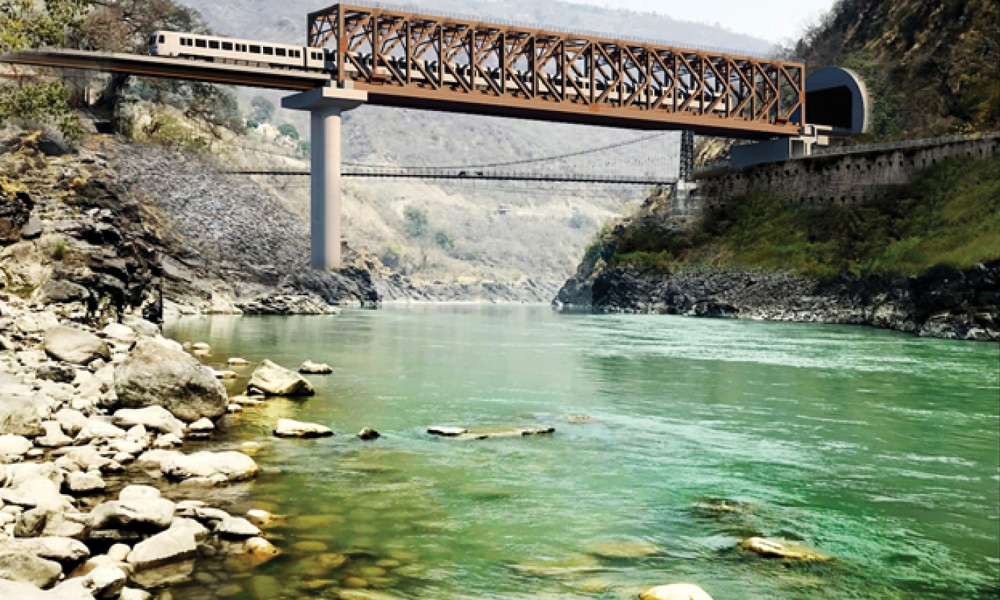
Uttarakhand’s first major railway infrastructure to facilitate better connectivity, the broad-gauge 125 km railway includes a record 125-meter bridge span crossing the River Ganges in a highly seismic zone. To streamline communication and minimize risks and project costs, Louis Berger established a connected data environment. Bentley’s integrated digital applications enabled them to complete the project while saving significant resource hours.

Rapid advancements in technology have also led to an increase in the gap between available technology and the user industry. Is it right to say that technology is outpacing customer demand and uptake?

There is this advancement gap between what’s possible and what the norm is in most projects. But that can be bridged. Take the case of India. I firmly believe that India can leapfrog the pace of Digital Twin adoption. At the onset of the pandemic, India lagged behind in virtualization and digitalization, but very swiftly it not only caught up and raced ahead but is also one of the fastest countries in terms of growth over the pre-pandemic period.

How do you see a convergence between Digital Twins and these connected, Smart Digital Cities?

It’s very interesting to see how Digital Twins converge with what we call Digital Cities. We can acquire operated 3D models through autonomous inspection, drone surveys, street-level surveys, etc., for our cities. We can then process them into as-operated 3D models. We haven’t yet fully discovered the prioritized use cases but we are confident of their viability in the long term.

For instance, in its Smart Reality 3D city landscape project for Mumbai, Genesis International used a proof-of-concept project that goes beyond Desktop GIS. They used Bentley’s ContextCapture software for reality modeling and our Orbit platform for 3D and 4D cloud-based immersion. This proved the feasibility of getting to a cloud-based solution.

Again, in a gas distribution project in Anand, Gujarat, Genesis International used the same toolkit and Bentley OpenUtilities environment to digitize the network, and ended up with what they call a web-based open source network for real-time insights. These are examples of steps taken toward converging Digital Cities and Digital Twins.

One important use-case accelerated by the pandemic has been mobility simulation, especially multimodal mobility simulation. Through acquisitions over the last few years, Bentley is now a global leader in multimodal mobility simulation. Our LEGION software environment was used for the Kumbh Mela Festival in 2017 for pedestrian simulation, but now the scope has been further expanded with our CUBE simulation.

A great case in point is the mobility models for Mumbai in view of the several lockdown phases and how that changed mobility use. Mobility simulation is always interesting in India because of the creative use of lane capacity. But these models take account of the value of time for decision-makers. And then you also have the notion of trip chaining in India, where you might use a taxi to get to a metro, then cycle to the final destination, and so forth. That’s a challenge that can only be answered with these multimodal simulations that we are best at now in Bentley Systems.

So, in Mumbai, we added the pedestrian simulations for train stations, metros, and so forth, and their social distancing aspects. This was a timely contribution that we made to increase the fitness and resilience of the infrastructure.

We are now ready to bring all this together when we have 3D and 4D as-operated city models.