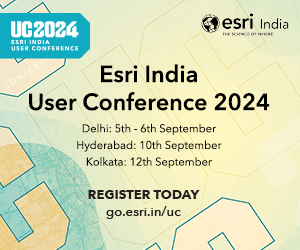
Esri India, the country’s leading Geographic Information System (GIS) solutions provider, has started the latest edition of its flagship conference, the Esri India User Conference (UC), at Delhi on 5-6th September.
The conference will move on to the other two locations, Hyderabad and Kolkata on 10th September and 12th September.
The theme of the conference is ‘GIS — Mapping a Better Future’. As India’s largest GIS conference, Esri India UC brought together GIS professionals, thought leaders, influencers, and key figures from the geospatial industry.
Agendra Kumar, Managing Director, Esri India said, “GIS serves as a crucial enabler of the future we all want to see. With GIS technology, we can unravel complex issues such as climate change, sustainability, and social inequity—and thereby discover where to take action. Fortunately, today organizations are rapidly welcoming GIS to enhance every sphere of their lives. From infrastructure development to enabling rightful/responsible use of utilities, communities are transforming themselves by adopting a geographic approach.
“The Esri India User Conference is an empowering opportunity to stay connected to the vibrant and innovative GIS industry; and as the GIS community connects here, we strive to create a robust GIS ecosystem, that powers business decisions, supports government operations, and creates a better world.”
Dean Angelides (Corporate Director – International Operations, Esri Inc.) talked about how the adoption of GIS is bringing a revolution across various sectors of the country, thanks to the users readily adopting a geographical approach to problem solving.
He said, “Our progress has come at a tremendous cost due to human-induced climate change, ecological instability and steep decline in biodiversity. To overcome these challenges, one needs to have shared understanding and collaborative action as well as bringing together the best information, science and tech and creative thinking”
“Maps reveal patterns, relationships and systems helping us think differently. The adoption of GIS is increasing at a rapid pace in India thanks to the users readily adopting a geographical approach to problem-solving.”
“Global Geospatial Infrastructure is rapidly emerging everywhere. Connecting thousands of organizations at all scales.”
Kunal Satyarthi, Joint Secretary, Department of Land Records, Ministry of Rural Development, Government of India highlighted four points on modernising land records.
Paperless registration: Make the registration system paperless, all legacy documents scanned and digitized and metadata available and searchable and integrated with land records.
Georeference every land record.
Online access: Making all RoRs and Cadaster maps online and digitally available.
Online court cases: Make the court case management system of revenue matters, online and integrated with land records.