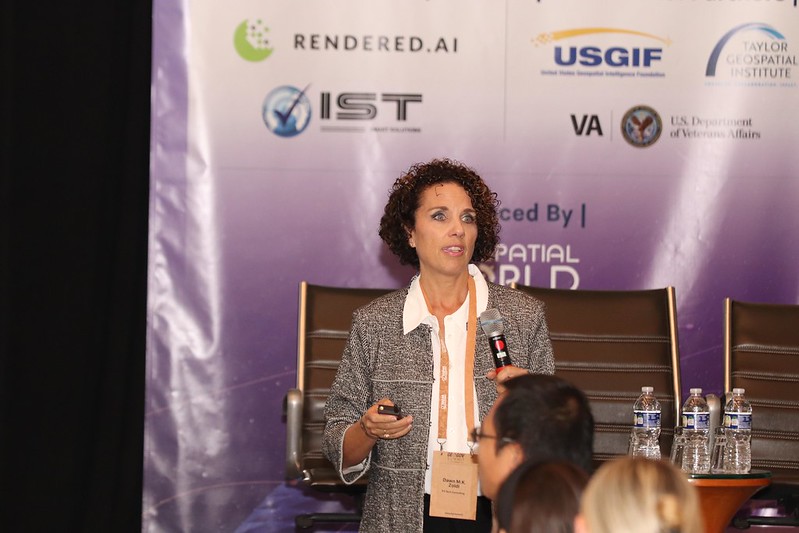
At this year’s GeoGov Summit, leaders from across the public and private sectors engaged in compelling discussions about the opportunities and challenges of moving toward a “whole of community” governance and coordination approach for National Spatial Data Infrastructure (NSDI). One noteworthy panel shed light on the implications of emerging technologies, capabilities and capacities emanating from various industry and research communities, as well as on the need for more equitable representation in decision-making relative to the geospatial ecosystem. Read on to better appreciate the perspectives of these government and industry leaders on the current status of the NDSI…and what it will take to advance it further.
An External NSDI Assessment
Moderator Cyril Smith, State Geographic Information Officer for the Commonwealth of Massachusetts, kicked off the discussion by presenting some eye-opening figures to illustrate the economic significance of geospatial data. Based on a 2007 ROI study commissioned by the Oregon Geographic Information Council, he extrapolated that state and local governments in the U.S. expand about $500 billion annually on geospatial data acquisition, use and management. Assuming similar spending by the federal government and private sector, Smith estimated the total annual expenditure on geospatial data to be around $2 trillion.
Despite these significant investments, an impending scorecard of the NSDI indicates more work needs to be done, particularly with respect to local government and private stakeholder involvement. Smith announced that the soon-to-be published 2024 NSDI Assessment from the Coalition of Geospatial Organizations (COGO), a non-profit entity composed of 13 professional organizations and trade associations that represent over 170,000 geospatial practitioners, illustrates his point.
COGO’s assessment, a voluntary effort involving about 40 people working across eight or nine committees over the past two years, aims to provide an objective evaluation of the NSDI. The assessment, modeled after the American Society of Civil Engineers’ infrastructure report card, grades various aspects of the NSDI.
The team used the original framework data themes as a proxy for the full suite of national geospatial data assets, as Smith said, “because it was beyond our capacity to do an evaluation of everything about the NSDI.” Those themes include the following data sets: address, cadastral, elevation, geodetic, government units, hydrography, orthoimagery and transportation.
Smith presented a summary of the assessment, which included grades for each data theme from 2015 and 2018 for reference purposes. While no category saw a downgrade from previous years, some categories remained static (cadastral, geodetic, government units, hydrography; note some of these are a solid A-) and only a few saw an uptick (elevation from B- to A- and orthoimagery from B- to B). Despite these shifts, the overall assessment has remained consistent since 2015 (C-). Smith, however, emphasized that progress on the original themes serves as a good indicator of progress for the NSDI as a whole.
One of the key recommendations Smith highlighted was the establishment of a national collaborative NSDI governance structure to enable the creation and management of the NSDI as a “collective shared investment.” “That means all the pertinent sectors have to have a seat at the decision-making table…” he said, “and that is not the case right now.”
State and Local Stakeholders’ Views
Building on Smith’s comments, Matt Sokol, Chief Data Officer for the Government of the District of Columbia (D.C.), brought his unique government viewpoint to the discussion. D.C. is a local government that also carries out state government functions and is closely intertwined with the federal government.
Sokol touched on the challenges of data sharing and collaboration between different levels of government. He highlighted the need for better mechanisms to facilitate data sharing and collaboration between local, state and federal entities. This includes addressing technical, legal and resource-related barriers that may prevent smaller jurisdictions from fully engaging with the NSDI.
Failing to address these issues, in Sokol’s opinion, raises questions about the value proposition of the NSDI for local governments, particularly smaller jurisdictions with limited resources. “What’s the value proposition to local governments?” Sokol asked. “For other local governments who are not a city like New York City or Washington DC, maybe, or a small county or city, and you’re a shop of 1 or 2 or less than that, maybe, what’s the value?”
Contrast this with the comments of Richard Wade, Deputy Executive Administrator of the Texas Geographic Information Office and outgoing NSGIC President. He shared Texas’s positive experience in developing a coordinated statewide geographic information system.
Wade recounted how Texas moved from a fragmented approach ten years ago to a more cohesive system today. “Fast forward ten years,” he reported, “and we have 99.5% of all addresses. We have 99.4% of all parcels. And we have the entire state of Texas in LiDAR over multiple years,” Wade reported. He emphasized the importance of building trust with different agencies and local partners to achieve this progress.
Both of these perspectives underscore the need for the NSDI to provide tangible benefits and support to state and local governments of all sizes. They also highlight the importance of considering the diverse needs and capacities of different jurisdictions when developing NSDI strategies and governance structures.
The Value of Public-Private Partnerships
Ryan Bank, Global Managing Director of the Geospatial Insurance Consortium (GIC) and John Copple, CEO of The Sanborn Map Company, offered thoughts on the NSDI from the standpoint of commercial industry. Both indicated public-private partnerships could provide a solution to maintain and update the NSDI.
Copple emphasized the wide-ranging commercial applications of the NSDI. He pointed out that many industries, from navigation to railroads to delivery companies, rely heavily on geospatial data. As with some of the other speakers before him, Copple also highlighted the challenge of maintaining and updating the NSDI. He suggested that leveraging private sector resources and expertise could help to maintain the NSDI’s relevance and accuracy.
To do this, Copple also suggested that creating universal standards would ensure consistent data sets across all stakeholders. He cited USGS’ 3DEP (3D Elevation Program) standards, which have been widely adopted, as a successful example of such standardization.
“The 3DEP standard that USGS created is now being used all over the world,” Copple noted. “These standards enable interoperability across different systems and applications, have opened up new business opportunities and improved capabilities in areas such as flood evaluation. The adoption of such standards not only enhances the usability and value of geospatial data but also facilitates collaboration and data sharing between different organizations and sectors. This aligns with the broader goal of creating a more integrated and accessible NSDI,” he said.
According to Copple, the key is “figuring out how to work together.” He emphasized that by leveraging the strengths of both sectors – the government’s ability to set standards and coordinate national efforts, and the private sector’s capacity for innovation and efficient data collection – the NSDI could be more effectively maintained and expanded.
For his part, Bank provided the insurance industry’s view. His opening comments addressed the current confusion, as an industry representative, about the exact nature of the NSDI. “I don’t know what the NSDI is,” he admitted. “Is it a framework? Is it infrastructure? Is it governance? Is it data? Is it a database? Is it a portal? Is it all of the above?”
Whatever it actually is, Bank emphasized the need to think about the NSDI holistically, creatively and inclusively – especially with regard to the private sector. To illustrate potential for private sector contributions to enhance and update the NSDI, Bank highlighted the extensive data collection efforts undertaken by the insurance industry. He noted that the GIC now collects aerial imagery and data for the entire United States multiple times a year, as well as for 41 other countries.
“We now collect aerial imagery and aerial data of the whole country, every single square centimeter of the lower 48 plus territories,” Bank explained. “We do that in oblique imagery multiple times a year at 7.5cm resolution.”
This level of data collection and frequency demonstrates the value the private sector can bring to the NSDI. It also raises questions about how such valuable data assets can be integrated into a national framework and made accessible to other stakeholders.
Bank proposed expanding the GIC model to other industries. He suggested that creating similar consortiums for sectors such as telecommunications, utilities and transportation could lead to more comprehensive and up-to-date geospatial data resources.
“Why can’t we have a geospatial telecom consortium and a geospatial utility consortium and a geospatial transportation consortium?” Bank asked. This idea of industry-specific consortiums working in parallel could potentially address some of the challenges in maintaining and updating the NSDI, he noted, while also fostering cross-sector collaboration.
Always Better Together
As the discussion concluded, it became clear that fully realizing the potential of the NSDI will require a multifaceted approach. It will involve close coordination between government entities at all levels, nonprofits, academia and private industry. It will also require clear governance structures, standardized data practices and innovative public-private partnerships. To be sure, the GeoGov Summit was a great catalyst for this type of forward thinking and collaboration.
Learn more about geospatial infrastructure, mapping and surveying, satellite imagery and remote sensing, location-based services, smart cities and urban planning, and much more at The GeoBuiz Summit 2025: https://geobuiz.com/summit-2025/