





















Climate Resilience and Disaster Management

Theme: Adapting Today, Thriving Tomorrow: Geospatial Solutions for Climate and Crisis

Seminar

01 May 2026


Overview

The Climate Resilience and Disaster Management Summit convenes global stakeholders to advance solutions for climate adaptation and disaster response. Leveraging geospatial data, AI, and IoT, it explores real-time monitoring of floods, wildfires, cyclones and extreme events via satellite imagery, enhancing early warning and recovery. Urban adaptation strategies integrate nature-based solutions, like green roofs and wetlands, with resilient infrastructure to address rising seas and heatwaves. AI-driven predictive modelling and crowdsourcing optimize disaster management, ensuring equitable resource allocation. Financial tools, including parametric insurance and relief funds, bolster safety and adaptability. The summit bridges forecasting to action, aligning stakeholder goals with sustainable infrastructure, energy and carbon management for resilient urban ecosystems.
Agenda

Leveraging Geospatial Data for Disaster Recovery and Response
  • Leverage satellite imagery and IoT sensors to monitor energy and infrastructure during disasters, ensuring rapid restoration.
  • Case studies on disaster response through imagery intelligence: Analyse asset damage using geospatial data to prioritize recovery and mitigate business and civic disruptions.
Climate Adaptation in Urban Environments
  • Tackling urban heat and water stress from climate change effects.
  • Nature-based solutions for a resilient cityscape and equitable land use planning.
  • Policy incentives for green adaptation: Driving systemic changes in the evaluation of safety, resilience, ease of living and working for city inhabitants in times if distress.
Nature-Based Solutions for Resilience
  • Policy frameworks: Incentivize nature-based renewable projects.
  • Ecosystems like wetlands and forests mitigate climate impacts, with energy-focused solutions enhancing resilience through renewable integration and carbon management.
  • Energy from ecosystems: Explore biomass energy from restored forests, using geospatial tools to ensure sustainable harvesting and minimal ecological disruption.
From Modelling to Action: AI and Crowdsourcing for Climate Resilience
  • Crowdsourcing for real-time disaster management: Facilitating energy supply in times of crisis, using AI to prioritize renewable energy deployment.
  • Leveraging community response to manage, capture and monitor requirements in times of disasters and climate change induced extreme weather events.
Climate Forecasting to Climate Adapted
  • Implement AI-driven carbon credit platforms for renewable energy projects and sustainability projects, verified by satellite data, to mitigate energy sector emissions.
  • Aligning shareholder goals and balancing climate resilience with financial returns in all sectors.
Reassuring Safety: Insurance and Finance
  • Financial mechanisms like disaster relief funds and insurance towards enhanced safety and adaptability, with a focus on assets in renewable energy, infrastructure and real estate.
  • Preparedness resulting from microfinance models, financial incentives and parametric insurance.
0930 - 0945
Opening Keynote Address
0945 - 1030
Panel Discussion: Advancing Global Resilience through Climate-Integrated Policy

Focus Areas

This session will examine how climate-integrated policy can strengthen global resilience in an increasingly complex, transboundary multi-hazard risk landscape. It will explore the role of advanced global climate risk modelling in enabling policy coherence across sectors and jurisdictions. The discussion will highlight the importance of interoperable geospatial systems to support evidence-based, cross-border decision-making. Finally, it will connect global frameworks such as the SDGs, Paris Agreement, and Sendai Framework to actionable strategies at national and local levels.
Peter Siegmund

Moderator

Peter Siegmund

Expert Climate
Royal Netherlands Meteorological Institute - KNMI
The Netherlands

Jara Villanueva
Jara Villanueva

Lead of the Centre of Sustainability and Resilience
European Space Policy Institute (ESPI)
Austria

Jelle de Jong
Jelle de Jong

Executive director
WWF-Netherlands
The Netherlands

Jennifer Marlon
Jennifer Marlon

Executive Director
Yale University
USA

Leon Wijnands
Leon Wijnands

Head of Sustainability
ING Nederland
The Netherlands

1030 - 1130
Presentation: Disaster Management in a Multi-Hazard World

Focus Areas

This session will explore strategies for disaster management in an increasingly complex multi-hazard environment. It will examine geospatial approaches to Hazard, Risk, Vulnerability, and Capacity Analysis (HRVCA) to enable integrated and data-driven risk assessment. The discussion will highlight the role of early warning systems in strengthening preparedness, evacuation planning, and risk communication. It will also address community-level adoption of geospatial technologies and the use of spatial data and analytics to enhance post-disaster needs assessment and recovery planning.
Ihwan Rafina
Ihwan Rafina

Founder & Director
MosaiX BV
The Netherlands

Katie Grillo
Katie Grillo

GIS Web Technology Specialist
Cambridge IT Department
USA

Hannah Walters
Hannah Walters

GIS Analyst
Denver Water
USA

Anand Sebastian
Anand Sebastian

Senior Scientist & Head, Geospatial Science and Technology Division
Integrated Rural Technology Centre (IRTC)
India

1130 - 1300
Networking Coffee Break Followed by Lunch
1300 - 1330
Presentation: Integrating Climate Finance and ESG for Global Sustainability and Risk Mitigation

Focus Areas

This session will examine how climate finance and ESG frameworks can be integrated to advance global sustainability and strengthen risk mitigation strategies. It will explore climate risk-indexed insurance and crop protection mechanisms, alongside parametric insurance solutions for coastal risk management. The discussion will assess evolving EU regulatory mandates and ESG disclosure standards in shaping transparent, risk-informed investment. It will also consider the role of carbon markets, including blue carbon and afforestation initiatives, in mobilizing capital for long-term climate resilience.
Christophe  Yvetot
Christophe Yvetot

UNIDO Representative to the EU, EIB, OACPS, Belgium and Luxembourg/Head of UNIDO Brussels Office
UNIDO
Belgium

Peter van der Werf
Peter van der Werf

Executive Director
Robeco
The Netherlands

1330 - 1415
Panel Discussion: Planning for Extremes - Climate-Smart Cities & Infrastructure

Focus Areas

This session will examine how climate-smart planning can strengthen the resilience of cities and critical infrastructure against extreme events. It will explore CRZ and flood zone overlays as tools for climate-resilient urban zoning, alongside adaptation frameworks for coastal hazards and flood-resilient infrastructure. The discussion will address urban microclimate analytics and heat stress prediction to inform proactive planning. It will also highlight the use of digital twins, 3D terrain, and hydrological modelling to enhance the design and performance of urban drainage systems, transport networks, and energy grids.
Jeffrey A. Carney

Moderator

Jeffrey A. Carney

Professor
Florida Institute for Built Environment Resilience (FIBER)
USA

Frans Keijzer
Frans Keijzer

Customer Solution Manager
TomTom
The Netherlands

Lisa Broekhuizen
Lisa Broekhuizen

Technical Director
Space4Good
The Netherlands

Dean Hintz
Dean Hintz

Team Lead - Strategic Solutions; Product Manager Open Standards
XML
Canada

John P Wilson
John P Wilson

Founder
USC Spatial Sciences Institute
USA

Hrishikesh Ballal
Hrishikesh Ballal

Founder
Geodesignhub
Ireland

1415 - 1500
Panel Discussion: Strengthening Disaster Management through Integrated Geospatial Systems

Focus Areas

This session will explore how integrated geospatial systems can enhance the effectiveness and responsiveness of disaster management. It will examine the use of AI, remote sensing, GIS, and Earth observation for real-time hazard detection and dynamic risk mapping. The discussion will highlight spatial decision-support tools, including UAVs and drones, to optimize emergency resource allocation and situational awareness. It will also address the role of mobile applications and multilingual alert systems in enabling timely last-mile communication and community action.
Jeff Hamerlinck

Moderator

Jeff Hamerlinck

Associate Director
University of Wyoming School of Computing
USA

Benedikt Graäler
Benedikt Graäler

Managing Director, Research
52° North
Germany

Samhita
Samhita

Founding CEO
Resilience AI
USA

Sonali Mishra

Co-Presenter

Sonali Mishra

Chief of Staff & Head of Partnerships
Resilience AI
India

Francesca Piatto
Francesca Piatto

Project Officer
European Association of Remote Sensing Companies EARSC
Belgium

Elena Field
Elena Field

GIS and Web Mapping Specialist
British Antarctic Survey
United Kingdom

Target Segments

City planners and urban development officials Landscape architects focusing on nature-based solutions Geospatial Technology Providers and Data Experts Renewable Energy Companies Carbon and Sustainability Experts Government Energy & Climate and Disaster Departments Financial and Insurance Sector Representatives NGOs and Community Organizations Academia & Researchers Policy Advisors and Policymakers

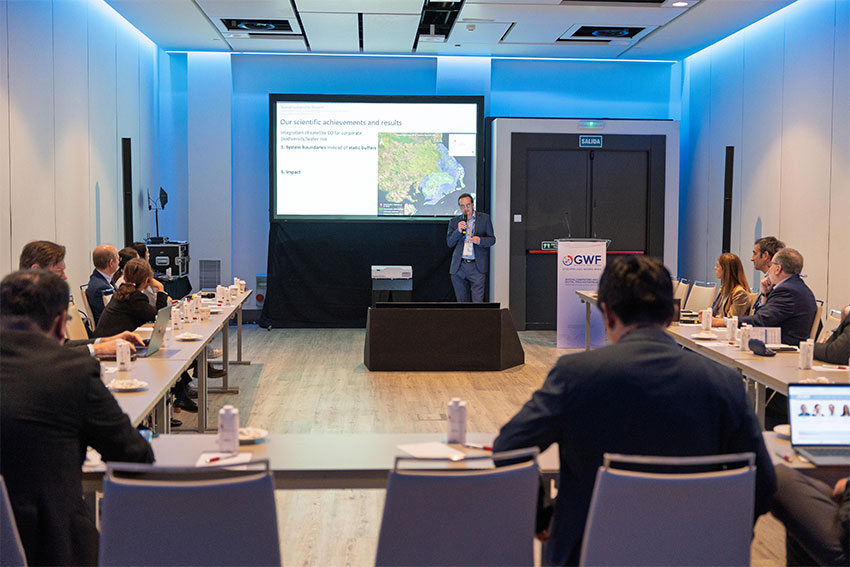
Glimpses from GWF 2025