Overview
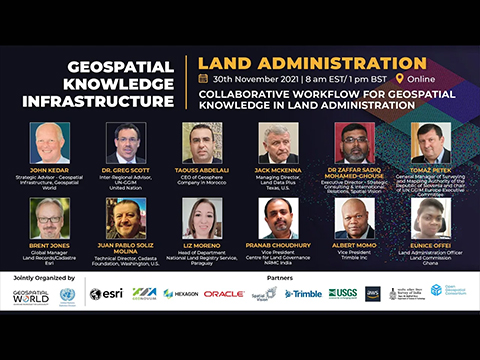
Land is the geo-fabric of any economy, and development of a well-planned Land Administration System is crucial for securing land tenures thereby contributing to the national economy. Creating and maintaining an effective land administration system is an intricate process managed by various agencies and organizations, with geospatial technology and applications being used for several aspects of the land administration workflow. But the impact of geospatial technology adoption will be realized effectively when it is applied across the entire cadaster workflow. The stakeholders of the land administration ecosystem including surveyors, private geospatial industry, land and cadastre agencies, policymakers, communities etc. have embraced innovations of the 4th industrial revolution and are evolving and adapting to use geospatial and frontier technology across the workflow.
The United Nations Committee of Experts on Global Geospatial Information Management (UN-GGIM) which has national cadastral and topographic mapping agencies as its members and private geospatial industry as observers have developed Framework for Effective Land Administration (FELA) for developing, reforming, renewing, strengthening and modernizing land administration and management systems thereby contributing to and supporting sustainable development. The Open Geospatial Consortium has a Land Administration Domain Working Group (DWG) which works on identifying enabling standards and best practices to establish more cost-effective, efficient and interoperable land administration systems. There is also a move away from the traditional top-down data collection approach by authoritative professionals towards bottom-up approaches of crowdsourcing supported by applications developed by private geospatial industry like Esri, Trimble, Cadasta, Leica etc. Geospatial Knowledge Infrastructure aims to develop a unified infrastructure and approach which brings together these disparate elements and places geospatial knowledge at the heart of the land administration ecosystem.
The evolving challenges associated with the dynamic and ever-expanding landscape of land administration necessitates a cognitive approach in the workflow, through integration of frontier technology including IoT, AI, ML, 5G etc. with geospatial data and technology thereby enabling an automated, collaborative, and participatory land administration system. The cognitive approach which places geospatial at the heart of the land administration workflow will enable effective decision-making by making real-time geospatial knowledge accessible to stakeholders across the workflow. It is crucial to identify the current state of adoption and integration of geospatial and frontier technology in the land administration workflow, along with the challenges and gap areas in order to project the value proposition of a collaborative workflow for geospatial knowledge, to identify the evolving roles of diverse stakeholders, and to explore new business and partnership models for collaborative innovation.
Discussion Points
- Current state of geospatial and frontier technology adoption in land administration
- Benefits and challenges of evolving geospatial and frontier technology ecosystem
- Value proposition of real time, geo-enabled data and knowledge for land administration
- Evolving roles of stakeholders and opportunities for collaboration
- Disruptive business models for geospatial knowledge co-creation
Who should attend
- Land and cadastre agencies
- Survey and mapping organizations
- Private geospatial industry
- Frontier technology companies
- Standards organizations
- Industry associations
- Academic institutions
- Land Consultancy Organizations
- International Development Organizations
- Non-profit Organizations
Agenda
AGENDA
Opening remarks: Setting the context

Dr. Shivangi Somvanshi
Director - Geospatial Knowledge Infrastructure, Geospatial World
Geospatial Knowledge Infrastructure and relevance for Land Administration

John Kedar
Strategic Advisor - Geospatial Infrastructure, Geospatial World
Guest address: Framework for Effective Land Administration (FELA)

Dr. Greg Scott
Inter-Regional Advisor, UN-GGIM, United Nations
Session 1: Adoption and integration of geospatial knowledge and 4IR technology in Land Administration workflow
- Current state of adoption of geospatial and 4IR technology (cloud, sensors, IoT, AI&ML, PNT, 5G) in Land Administration
- Integration of geospatial knowledge platforms and 4IR technology for data analysis and knowledge creation
- Where are there further opportunities for the use of geospatial knowledge within the sector?

Taouss Abdelali
CEO, Geosphere, Morocco

Jack McKenna
Managing Director, Land Data Plus, Texas, U.S.

Dr Zaffar Sadiq Mohamed-Ghouse
Executive Director - Strategic Consulting & International Relations, Spatial Vision

Walter T. de Vries
Chair - Land Management Group, Technical University Munich
Break
Session 2: Evolving roles and business models in Land Administration ecosystem
- Evolving value chain of geospatial knowledge in the ecosystem
- Need for new business models accounting for evolving role
- Benefits and challenges to user industry
Tomaz Petek
General Manager, Surveying and Mapping Authority of the Republic of Slovenia

Brent Jones
Global Manager, Land Records/Cadastre, Esri

Juan Pablo Soliz
Technical Director, Cadasta Foundation, Washington, U.S.
Session 3: Public private collaboration in Land Administration ecosystem
- Current state of collaboration
- Current and future areas of collaboration
- Types of collaboration - collaboration and partnership models
- What needs to change to improve geospatial knowledge collaboration?

Liz Moreno
Head of Department, National Land Registry Service, Paraguay

Pranab Choudhury
Vice President, Centre for Land Governance, NRMC India

Albert Momo
Vice President, Trimble Inc

Eunice Offei
Land Administration Officer, Land Commission, Ghana
Closing remarks

Ruban Jacob
Project Manager - Geospatial Knowledge Infrastructure, Geospatial World