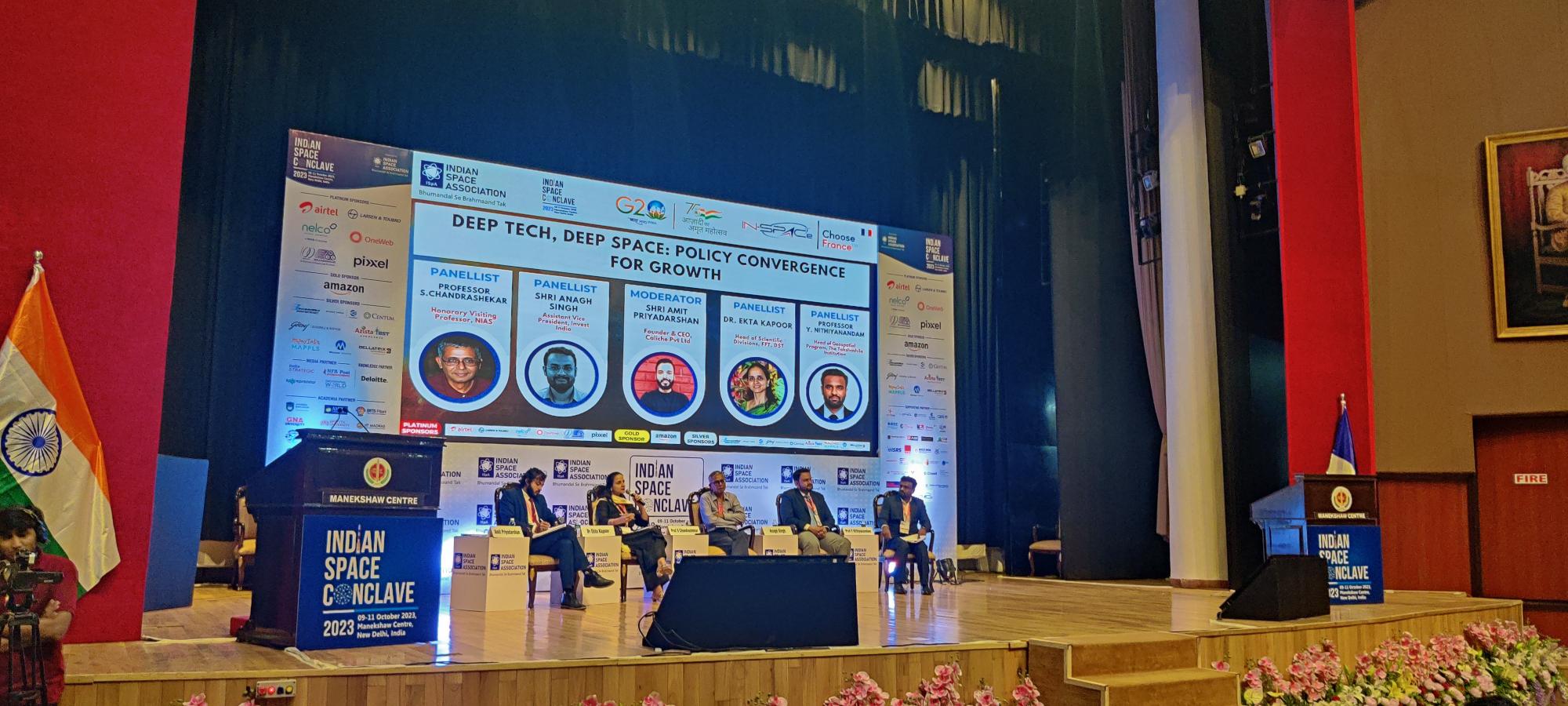
In the Opening Session of the Indian Space Conclave 2023, held at Manekshaw Centre in New Delhi, the panel discussed the convergence of Deep Tech and Deep Space Policy in growth. Deep Tech refers to innovation founded on advanced scientific and technological breakthroughs.
Anagh Singh, Vice President of Invest India, talked about how Deep Tech is in its nascent stage in India. He said, “As of 2023, there are around 3500 Deep Tech startups in India, and the potential growth of these startups is a very promising 40% this year.”
He further emphasized that India should not only be a buyer and seller of space tech but should also license out these tech products and have joint ownership of the intellectual property. Incremental procurement for the end-user is extremely crucial and necessary. From a defense perspective, technology should be used as a lever to prevent strategic surprises, said Anagh Singh.
These breakthroughs, with their disruptive nature, have the potential to solve India’s most challenging societal issues. There is a need for policy that can formulate and utilize these breakthrough technologies to stimulate innovation, spur economic growth, and promote societal development.
Space and India’s Aspirations
Space assets play a vital role in the formulation and implementation of great power strategies across the globe. They act as a multiplier that can enhance national power and prestige. The acceptance of this reality and the need to reorganize and restructure India’s Space Industry are of foremost importance.
This was emphasized by Professor Chandrasekhar of NIAS India, who said, “Economic and national power are the hard constituents of National Power and need a strong industry base.”
Space assets like Small Satellites are equally used for both military and civilian purposes. The challenge now for India is the need for an enormous number of satellites, including small, medium, and large ones. Prof. Chandrasekhar further adds that 220 PSLV, 108 GSLV, and small satellite launchers are also the need of the hour. He said, “The scale-up represents a huge opportunity to create a strong industry-based space ecosystem in the country.”
Several areas of technology, such as ion propulsion, infrared and antennas, ELINT (electronic intelligence gathered from electronic signals, etc.), TDRS, and SSA satellite development, require substantial investments.
Need for National Deep Tech Startup Policy
This initiative centralizes on bolstering deep tech startups, thereby solidifying India’s financial stability and stimulating the transition towards a knowledge-centric economy, consequently augmenting India’s overall productivity.
NDTSP aims to harness the transformative potential of technological advancement across diverse sectors, serving as a catalyst to stimulate ripple effects throughout the economy and laying the groundwork for new industry creation. This policy aims to significantly strengthen India’s capabilities and enhance global competitiveness.
The National Geospatial Policy seeks to strengthen the geospatial sector to support three objectives: National development, Economic prosperity, and a thriving information economy. It allows for the development of ecosystem markets. It seeks to assist the BFSI segment in understanding risk and underwriting loans. But how does the NGP and NDTSP synergistically converge?
Professor Y. Nithiyanandan, Head of Geospatial Program at The Takshashila Institution, talks about four different aspects of how it helps. He said, “It aims to create open data access for the national geospatial policy. It helps in opening up the commercial sector more, building skills in the aforementioned areas, and developing international collaboration in the Geospatial Field.”
Dr. Ekta Kapoor, Head of Scientific Divisions at FFT, DST, says, “Silos should not be created, and society should go hand in hand in national development.”
Deep Technology helps with developing Geospatial Datasets and New Geospatial Tech, especially in fields like precision agriculture and satellite technology.