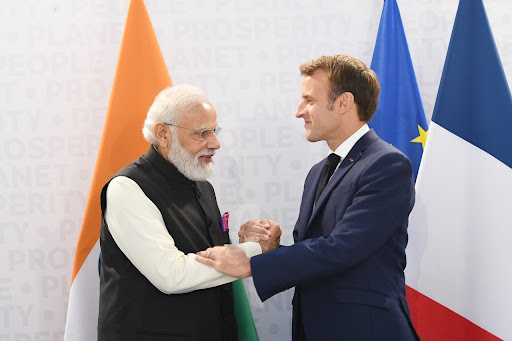
Indo-French space partnership has been evolving since the inception of the Indian space program back in the 1960s.
Recently, the two countries initiated a bilateral strategic dialogue on space issues and developed a thermal infrared satellite project.
“Building on a great tradition of over 60 years of technical and scientific space collaboration and to address the contemporary challenges in space, India and France have agreed on setting up a bilateral dialogue on space issues,” says the joint statement, which cements this partnership.
Joint Synergies
The partnership began in the early 1960s when India’s first sounding rocket launch carried a French payload. India’s Department of Atomic Energy (DAE) soon signed a MoU with the French space agency Centre National D’Etudes Spatiales (CNES) for training ISRO scientists.
A crucial project came in the 1970s when ISRO and CNES worked together on developing the Viking engine. This engine was utilized in the liquid-fuelled stages of ISRO’s Polar Satellite Launch Vehicle (PSLV), Geosynchronous Satellite Launch Vehicle (GSLV), and the Geosynchronous Satellite Launch Vehicle Mark III (GSLV Mk III).
“I always reflect upon the two countries’ joint development of two satellites, Megha Tropiques and SARAL, as a key example of synergies,” says Sanjay Nekkanti, Founder, Dhruva Space.
Launched in 2011, the Megha-Tropiques satellite studied the life cycle of convective systems that influence tropical weather and climate and their role in the associated energy and moisture budget of the atmosphere in tropical regions.
Two payloads; the Sounder for Probing Vertical Profiles of Humidity (SAPHIR) and Scanner for Radiation Budget Payloads (ScaRaB) were supplied by CNES, while another Microwave Analysis and Detection of Rain and Atmospheric Structures (MADRAS) were jointly developed with ISRO for developing SARAL (Satellite with ARGOS and ALTIKA) which was launched in 2013.
SARAL, the satellite with ARGOS and ALTIKA was launched in 2013 to study oceanography. The satellite later proved to be useful for various fields such as marine and meteorology and sea state forecasting, climate monitoring, biodiversity protection, seasonal forecasting, and improving maritime security.
“The bilateral relationship is one built on trust and assurance of each Nation’s technological and developmental capabilities, and it is encouraging to see this has not changed,” adds Nekkanti.
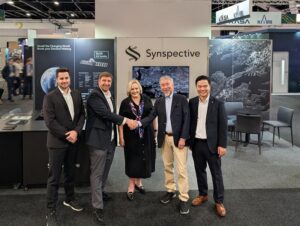
The recent burgeoning of private space companies around the world has also cultivated a collaborative nature of inter-nations. Dhruva Space shook hands with French SatCom Company Kinéis for a joint technological and commercial space project to enhance Kinéis’ global IoT connectivity.
“Cooperation between CNES and ISRO is among the most longstanding and successful there is, not only for France and India, but in the entire history of astronautics,” says CNES Chairman & CEO Philippe Baptiste.
Unique Opportunities
India and France have their own set of fortes and challenges. One is capable of successfully launching satellites into space at a relatively lower cost while the other has a stronghold in research and development and manufacturing processes.
“France is a major space player in Europe with the only launch system (Ariane 6) available in Europe; India is building its medium and heavy-lift rockets by 2030. Collaboration towards building launch systems, and satellite manufacturing is a great way forward between France and India,” states Dr. Namrata Goswami, an author, professor and consultant specializing in space policy, international relations.
“Both the countries have committed to working on space norms and guidelines through United Nations Committee on the Peaceful Uses of Outer Space (UNCOPUOS). This is a vital step as both India and France are major space players in their regional context.
“Collaboration between India and France on norms regarding responsible use of space, space capabilities like satellite manufacturing and launch systems, and building resilient supply chain mechanisms, will empower both France and India to establish their status as major powers in space. Collaborating on missions to the Moon and Mars is another venue for space cooperation,” she adds.
“A combination and exchange of capabilities is definitely possible between both the nations. Now that India is aiming to launch a human spaceflight mission in the coming years, countries like France might emerge as the potential partners or collaborators,” believes Omkar Nikam, Space and Defence expert.
ISRO’s Gaganyaan mission, a human-flight rocket bound for space in 2025 – has been hailed as an ambitious plan by no small means around the world. The mission is to launch three astronauts into space to carry out space research and exploration activities and demonstrate India’s capability to launch and safely return the crew to the Earth.
To aid the mission, CNES signed an agreement in 2021 under which equipment developed by the space agency, tested and still operating aboard the International Space Station (ISS) will be made available to Indian crews for training purposes.
Moreover, the CNES will also be supplying fireproof carry bags made in France to shield equipment from shocks and radiation.
“Both the countries recognize the pivotal role that space applications play in economic and social development. From natural resource management to disaster prediction and rural connectivity, their joint space projects have real-world impacts, improving the lives of their citizens and contributing to national development,” states Eric Fajole, Trade Commissioner – Embassy of France in India.
Structural Limitations?
Working under the ambit of the European Space Agency (ESA), CNES still has to prioritize the European market and capacity building over venturing into the outer world.
“CNES will not be as open as maybe the US in terms of selling,” avers Awais Ahmed, Founder & CEO, Pixxel.
“But of course I think there’s possibilities for working together with French companies to expand into the European market, through European space agency programs and so on,” he adds.
However, with regular agreements and MoUs signed between the nations, the critiques might not be far-fetched. Two years ago, ISRO launched the Oceansat-3 satellite – dedicated to studying oceanography and atmospheric studies – the payload named ARGOS was provided by France.
For one, the governmental agreements might dry up, but the recent uprising of private space companies in India may bag the chance. “We’re seeing joint ventures coming, space players and the French space players. So there was traditional cooperation between CNES. Now we are looking at it spreading from industry to industry,” says Lt. Gen (Retd) AK Bhatt, Director General, ISpA (Indian Space Association).
Note: Nibedita Mohanta, Assistant Editor, contributed to this article