Amazon Web Services (AWS) announced at AWS re:Invent 2022, in Las Vegas, that it successfully ran a suite of AWS compute and machine learning (ML) software integrated on SpaceCloud on an orbiting satellite, in a first-of-its-kind space experiment, conducted over the past ten months in Low Earth Orbit (LEO).
This was designed to test a faster, more efficient method for customers to collect and analyze valuable space data directly on their orbiting satellites using the cloud.
As per a blog by Clint Crosier, Director of Aerospace and Satellite Solutions, AWS, the experiment will let customers automatically analyze massive volumes of raw satellite data in orbit and only downlink the most useful images for storage and further analysis, driving down cost and enabling timely decision making.
Why and how it started?
Latency is the time taken for data to pass from one point to the other on a network. High latency and limited or no bandwidth networks are one of the major challenges faced by the space industry.
AWS collaborated with D-Orbit and Unibap, two of its global space partners, to eliminate these technical challenges associated with space operations. D-Orbit is an Italian space logistics and transportation service company, and a member of the AWS Partner Network (APN).
Together, they were able to build a software prototype for tools essential for the Earth Observation (EO) mission. This includes AWS ML models to analyze satellite imagery in real-time, and AWS IoT Greengrass which is able to provide cloud management and analytics even during periods of limited connectivity.
“Our customers want to securely process increasingly large amounts of satellite data with very low latency,” said Sergio Mucciarelli, Vice President – Commercial Sales of D-Orbit.
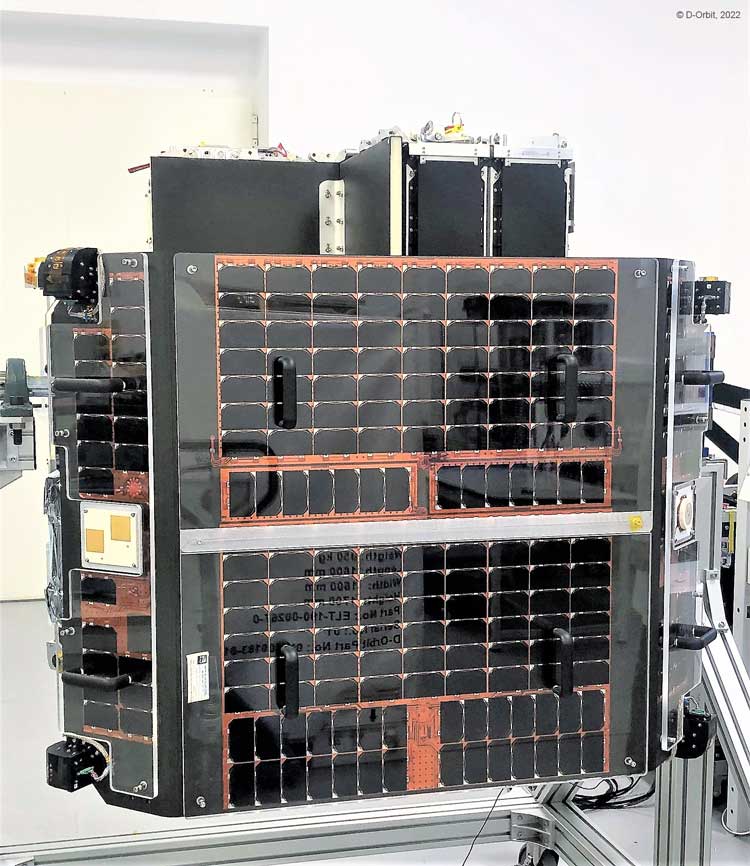
By applying AWS compute and machine learning services to EO imagery, D-Orbit could rapidly analyze large quantities of space data directly onboard its orbiting ION satellite.
“Using AWS software to perform real-time data analysis onboard an orbiting satellite, and delivering that analysis directly to decision makers via the cloud, is a definite shift in existing approaches to space data management. It also helps push the boundaries of what we believe is possible for satellite operations,” said Max Peterson, AWS Vice President, Worldwide Public Sector.
The prototype was integrated into a space-qualified processing payload built by Unibap, a high-tech company based in Sweden. The Unibap processing payload was then incorporated into a D-Orbit ION satellite and launched into space.
Earlier this year, on January 21, the team made its first successful contact with the payload and executed the first remote command from Earth to space. The team began running its experiments a few weeks later.
What are the benefits?
Space missions collect vast volumes of satellite data daily. But this data is useless if it can’t turn into actionable insights, and it’s not helpful if the satellite operator has to wait nearly a full day to send that data back to Earth to use it.
AWS AI/ML reduces massive raw images and data files by 42 percent. This helps speed up processing time and enables real-time insights, which means faster time for insights, communication, and decision-making for satellite and ground crews.
“We want to help customers quickly turn raw satellite data into actionable information that can be used to disseminate alerts in seconds, enable onboard federated learning for autonomous information acquisition, and increase the value of data that is downlinked,” said Dr. Fredrik Bruhn, Chief Evangelist in Digital Transformation and Co-founder of Unibap.
The experiment will carry on into 2023. AWS will work closely with D-Orbit and Unibap to test additional capabilities. They would explore additional approaches for processing raw data on orbit and more refined data delivery methods.